






The paper stack on your desk tells a story. A new patient sent in a nine-page intake form last week. Half of it is legible, a third of it is empty, and somewhere between the medications list and the timeline of symptoms there is a note in the margin that says “see attached.” The attachment is missing. You’ll sort it out during the consult — which now starts ten minutes late because the front desk is chasing another form that was never received.
Intake is where functional medicine consults are quietly won or lost. Generic intake forms weren’t built for a discipline that needs a full timeline, symptom scores, family history, food and lifestyle patterns, prior labs, and consent for advanced testing — before the first minute of billable time. Customizable intake forms for functional medicine practices exist for exactly this reason: to move the paperwork out of the consult room and into a structured, digital flow the patient completes at home.
Why generic intake forms fall short
A standard medical intake asks for the basics: contact details, insurance, chief complaint, medications. A functional medicine intake needs to go much further. You are trying to piece together a decade or more of environmental exposures, gut health markers, sleep patterns, stress inflection points, and the exact order in which symptoms appeared. That takes structured questions, not open text boxes.
When practices try to force this into a generic PDF or a booking-tool add-on, three things break down. Patients skip the questions that feel repetitive. Practitioners can’t compare data across visits because the format shifts. And the front desk becomes the middleman for every incomplete or missing form, spending hours a week on emails that should never have been necessary.
What “customizable” should actually mean
Customization is a word that gets overused. In a functional medicine context it should mean four concrete things:
- You can build the questions your protocols require — timelines, scale ratings, symptom clusters, dietary categories — without asking a developer.
- You can clone forms so the intake for a hormone consult, an autoimmune workup, and a GI protocol don’t all look the same.
- Patients can save their progress and come back later, so a long form doesn’t get abandoned halfway through.
- The completed form lives in one place — the patient record — not in an inbox thread or a shared drive folder.
If any of those four is missing, you’re back to chasing paperwork before every consult.
How Practiceflow handles intake for functional medicine
Practiceflow was built with functional and integrative practices in mind, so the forms module is designed around exactly this workflow. A drag-and-drop editor lets you assemble intake forms, informed consents, and medical symptom questionnaires (MSQs) using predefined question templates — scale ratings, timeline elements, multiple choice, structured text. When a form works, you clone it and adapt for the next consult type. No developer required, no waiting for a support ticket.
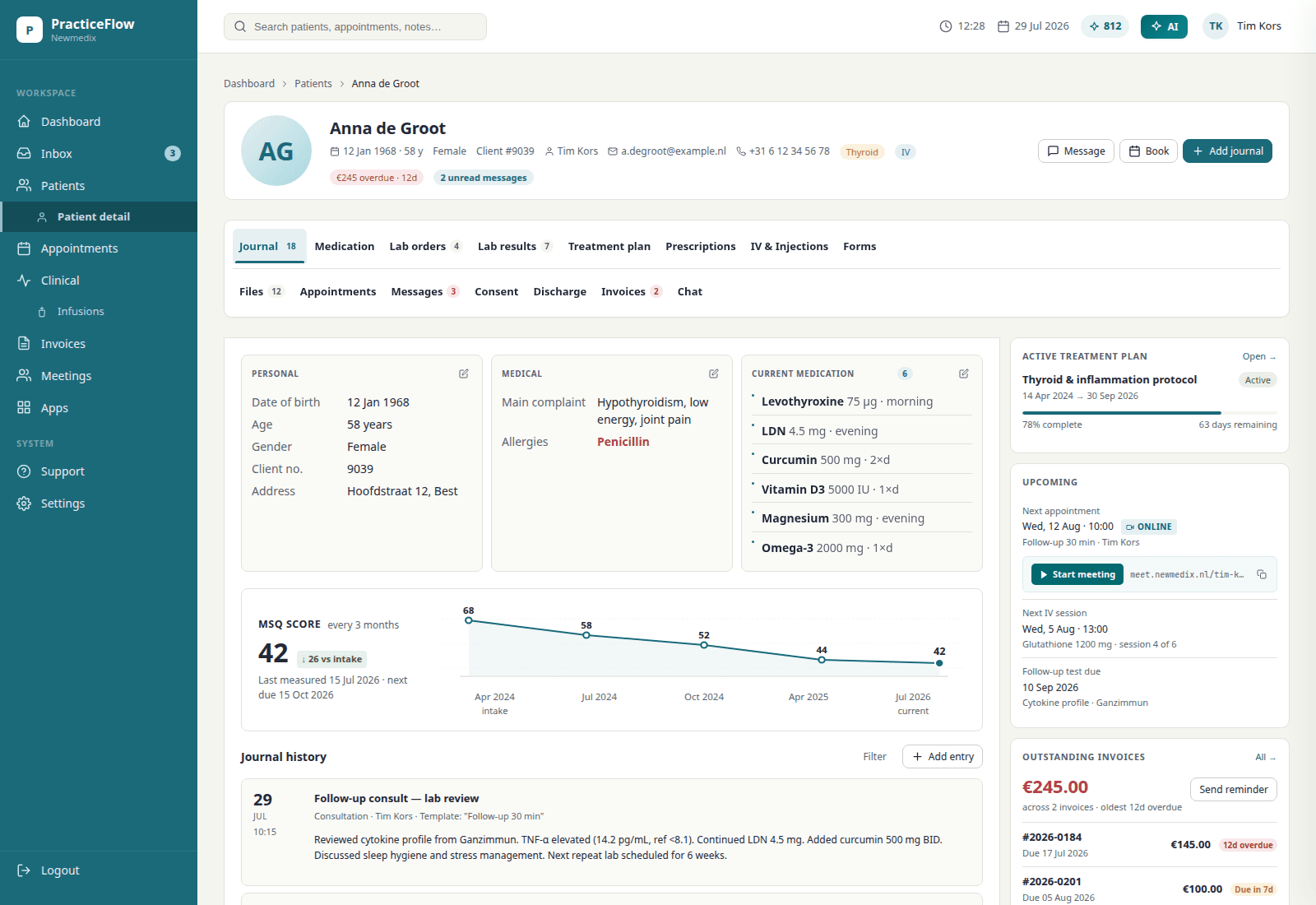
Patients complete the forms through the patient portal at their own pace. Auto-save runs quietly in the background, so a form started on the sofa in the evening can be finished at breakfast the next morning without losing a single answer. Once submitted, the response lands directly in the patient record, alongside their appointment history, treatment plan, and lab results. Your front desk stops chasing. You stop asking the same question twice.
The quieter effect on the consult itself
When intake is complete before a patient walks in, the consult changes shape. The first ten minutes are no longer spent piecing together a history — they’re spent asking the questions only a practitioner can ask. Patients notice this. They arrive feeling that the practice already understands them, which raises trust before a word is spoken. Practitioners notice it too: the appointment feels less like triage and more like the work they trained to do.
This is also where structured intake pays off between visits. Because the data is captured in a consistent format, the same MSQ can be re-sent at three months and six months as part of automated follow-up. You see the pattern, not just the snapshot — and the pattern is where functional medicine lives.
Where to start
If intake is currently absorbing hours of your team’s week, the fix is rarely more effort — it’s a different tool. Start with the two forms you use most often, rebuild them with the questions your protocols actually need, and let the software carry the follow-up. Everything downstream — the consult, the treatment plan, the retest schedule — gets calmer once the front of the funnel finally works. For a broader view of how a practice comes together as one system, our post on one platform for the whole team walks through the same principle applied across scheduling, forms, and follow-up.
Ready to streamline your functional medicine practice? Try Practiceflow for free today — no obligations.