
The record
Functional medicine EHR
I am Tim Kors, IFM Certified Functional Medicine Practitioner. I opened my practice in 2006. For ten years I watched the record fragment across three portals, a Word folder and a shared drive; in 2017 I started building the record I actually wanted to open on a Monday morning. A functional medicine EHR, as I use the words, is not a synonym I threw at Google. It is the record itself: first intake to last follow-up, years of labs, plans and notes in one file that your team can work in and your patient can actually see. I designed a file I was willing to open on a Monday morning when the last visit was in November and the labs had arrived in three formats.
The EMR page is the consult — finishing the chart in a 60–90 minute visit. This page is what that chart becomes over a year. If the file fragments, you do not have an EHR. You have archaeology. The category hub is functional medicine software. Mixed-modality clinics should also read integrative medicine EHR.
I am still in the clinic. I did not design a record for a boardroom. That is the only honesty I can offer on an EHR page.
Years of labs are not an archive problem. They are a clinical problem. What changed. What you already ran. What you said you would repeat. An EHR that cannot put those answers on one screen will always lose to a spreadsheet, and then you are back to two records. I refused that split in my own practice.
Search will keep sending you EMR and EHR as if they were two vendors. They are two pains. Cross-links exist so you can enter through either door and still land in the same clinic file. Start for free when you are ready to test that file. No credit card. No invented awards. I am Tim Kors. The file has to work on Monday.
One file from first intake to last follow-up
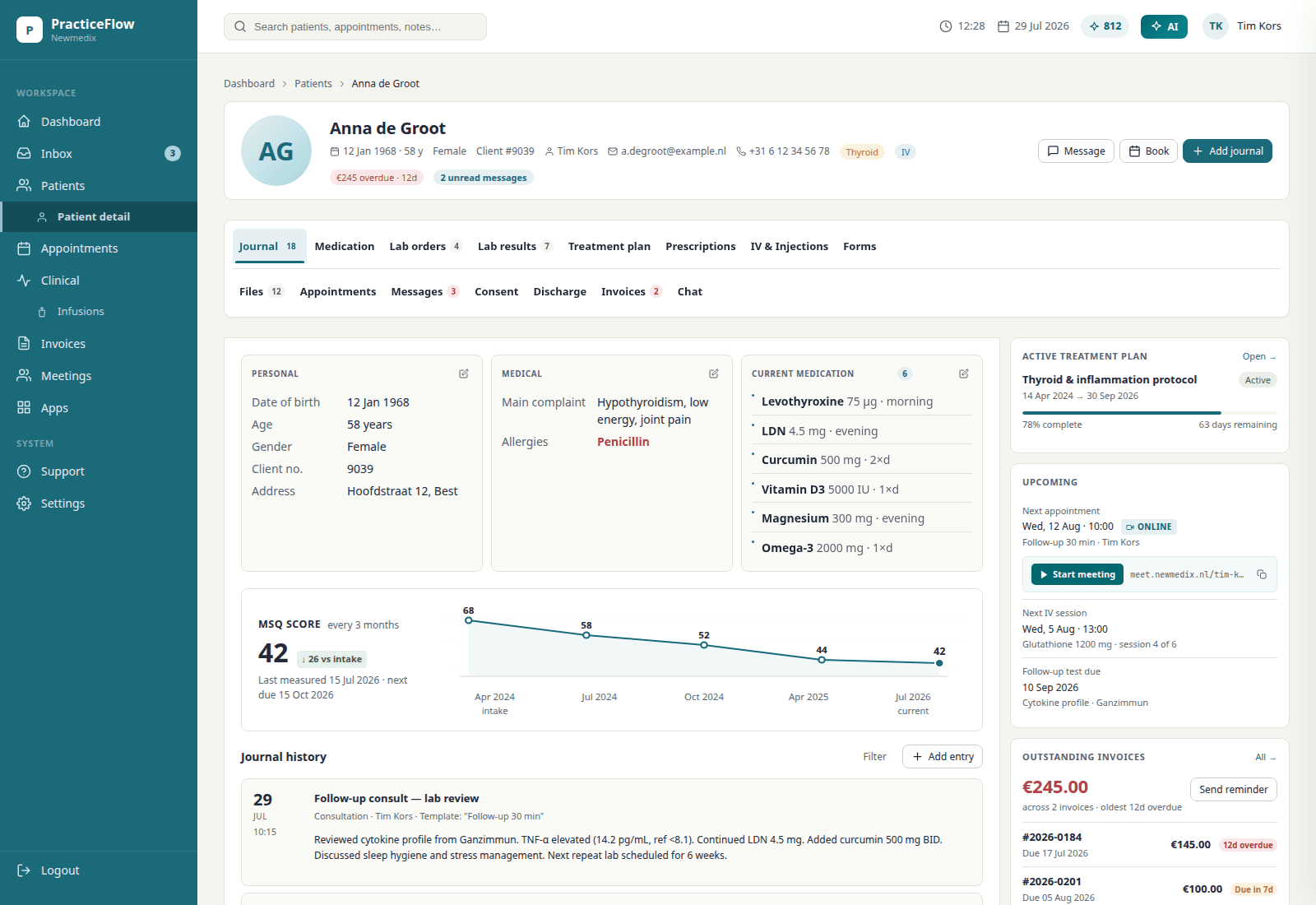
Liana Verberg put it as an all-in-one file from the first appointment to the last treatment. That is the EHR job. Interview reports, medication overview, lab requests, treatment plan and quote live on the same patient record. You should not need a detective hour to reconstruct a case before a follow-up.
Functional medicine cases run long. Three months, six, a year. Retests, tapers, the protocol that changed in April. If each of those lives in a different inbox, the record is a collage. I built Practiceflow so the collage is the file. Walk into the consult with the last interview, plan and labs already on screen. That is an EHR behaviour, not a calendar behaviour.
When people search functional medicine EMR vs generic EHR, they are usually feeling this gap. I wrote EMR vs generic EHR and EMR vs generic EMR for that comparison in essay form. This landing is the product argument: one record, on purpose.
One file is also how you stop repeating yourself. The patient should not have to re-tell the 2008 hospitalisation because the 2024 note cannot see it. The practitioner covering your leave should not have to guess. That is the EHR, not a courtesy.
Labs from any provider, on the patient
I do not want an EHR that only speaks to one lab company. Practices already have relationships. Stool, hormones, organic acids, food sensitivity, blood chemistry — often three portals and a PDF graveyard. The clinical work is interpretation. The operational work is making sure the result is on the file when you need it.
A functional medicine EHR should let you request labs from labs you already use, log the request against the patient, keep results in the same record, reorder a repeat panel from the last request. I described the mess in lab results management and functional medicine lab results. The EHR test is whether you can answer which markers you ran and what changed without leaving the chart.
Retesting is part of the same file. A retesting schedule that is not on the record is a wish. Markers only make sense over time. The EHR is that timeline, not a folder of PDFs named final-final-2.
A portal so the plan is not a PDF in a coat pocket
Patients forget. Not because they do not care. Because the plan was seven pages and a verbal summary at the door. A functional medicine EHR that stops at the practitioner screen still dumps the work onto email. “What was I supposed to take again?” is an EHR failure as much as a communication failure.
Practiceflow gives patients patient portal access to their plan. Liana’s quote is specific: considerably fewer questions via email and telephone when the total treatment is clear. That is the record doing work after the visit. It is not a marketing chatbot. It is the same file, readable.
I am not claiming the portal replaces a consult. I am claiming the plan should not evaporate between visits. If the patient can see what they agreed to, you spend the follow-up on what changed, not on reconstructing the PDF they lost.
A team record, not a personal notebook
Solo practices become two practitioners and a locum. If the EHR is really “Tim’s Word folder,” you do not have a clinic. You have a bottleneck. Shared templates, shared protocols, patient-level edits, team access — so onboarding a practitioner is days, not a re-implementation.
I wrote multi-practitioner functional medicine software and team productivity about that shift. The EHR is the shared object. The practice management page is how that object saves owner time. Same product, different question.
A team record also means the protocol library belongs to the clinic. Standard protocols stay consistent; patient-level edits stay on the person. That is how quality survives a holiday, a locum, or a second practitioner with a different typing style.
HIPAA and GDPR are the published trust lines. Patient data lives on infrastructure I would be willing to explain to my own patients, because I still see mine on this record.
I will be blunt about what this is not. It is not a hospital EHR programme. It is not a badge wall. It is a clinic file for IFM and integrative work: long enough, searchable, shared, with labs on it. If you need enterprise theatre, you are in the wrong shop. If you need Monday morning to make sense, you are not.
Where this EHR sits versus alternatives
You will see Practice Better, Cerbo, OptiMantra and Hero EMR in the same searches. Real products. No table, no fake scores. Some EHRs are closer to a conventional chart with extra fields. Some platforms are closer to client-management for programmes. A functional medicine EHR, as I built it, is organised around the long file: labs from any provider, plans that are not diagnosis-code shaped, follow-up that belongs on the record, a portal, a team.
If you need the visit-level charting story, go back to the EMR. If you need mixed modalities — acupuncture plus infusions plus nutrition in one clinic — read integrative medicine EHR. To see the screens, walk Features.
EHR, EMR, software — same clinic, different door
Search engines treat EMR and EHR as cousins. I keep both pages because practitioners use both phrases for slightly different pain. EMR: I cannot finish the note. EHR: I cannot find the case. Functional medicine software is the category. Practiceflow is one system. I am not going to pretend they are three products.
Start for free, no credit card, on a real file. See pricing for paid plans — by client volume, in dollars.
If you have been hurt by a generic EHR, you already know the symptoms: the intake does not fit, labs are a side quest, the plan is a Word file, follow-up is a memory. I built this record so those symptoms have a place to go. I still practise. I still open the same kind of file you will open. That is the whole credential. IFM certified, clinic since 2006, software because the chart was the bottleneck.
Read the EMR if your pain is tonight’s note. Stay here if your pain is last year’s case. Then start free or watch the video tour. Features is the tour of every screen.
From practitioners already using it
These are the published quotes, word for word. No invented reviews.

“With Practiceflow, I keep track of my patient interview reports in a very user-friendly way. Also, I have a particularly good overview of the total treatment for the client. A real 'all-in-one solution': everything is clear from the first appointment to the last treatment. As a result, considerably fewer questions via email/telephone.”

“I work as a functional medicine doctor. With the software, a patient-personalized treatment plan is ready in a matter of minutes. Requesting lab tests and using text templates also saves me a lot of time, so I have more time and focus for the patient.”

“As a functional nutritionist, I use the software to make treatment plans and interview reports. Practiceflow is very user-friendly, easy to use, and easy to learn. With Practiceflow, I can do patient file management at least 50% faster.”
Still writing treatment plans at 9pm?
About 20 questions on how your intakes, lab portals and plan write-ups actually run. You get a report back showing which step is eating the hours.
Questions
Keep reading: Functional medicine EMR · Functional medicine software · Integrative medicine EHR · See every screen · Free practice scan
