
Category
Functional medicine software
I am Tim Kors, an IFM Certified Functional Medicine Practitioner. I did not set out to become a software founder. I opened my practice in 2006 and spent the first ten years doing what everyone does — losing the evening to charting, chasing labs across three portals, rebuilding treatment plans in Word. I started building Practiceflow in 2017 because nothing on the market held the shape of my week: a long-form intake, labs sitting in three portals, and a treatment plan that covers supplements, medication, infusions and nutrition — without the evening becoming a second unpaid shift.
That is what functional medicine software has to do. Not a calendar with a notes box. Not a generic chart dressed up with a wellness theme. The work is long, layered, and longitudinal. If the tool was built for a ten-minute GP visit, you will feel it by Wednesday.
I built it for my own clinic first. Other practices use it now. This page is the whole product: who it is for, and how to choose. The functional medicine EMR and functional medicine EHR pages are the chart and how information in the record is used. Practice management software is scheduling, team tasks, administration, and billing. Journal articles each take one concrete practice problem. The product tour of every screen remains on Features.

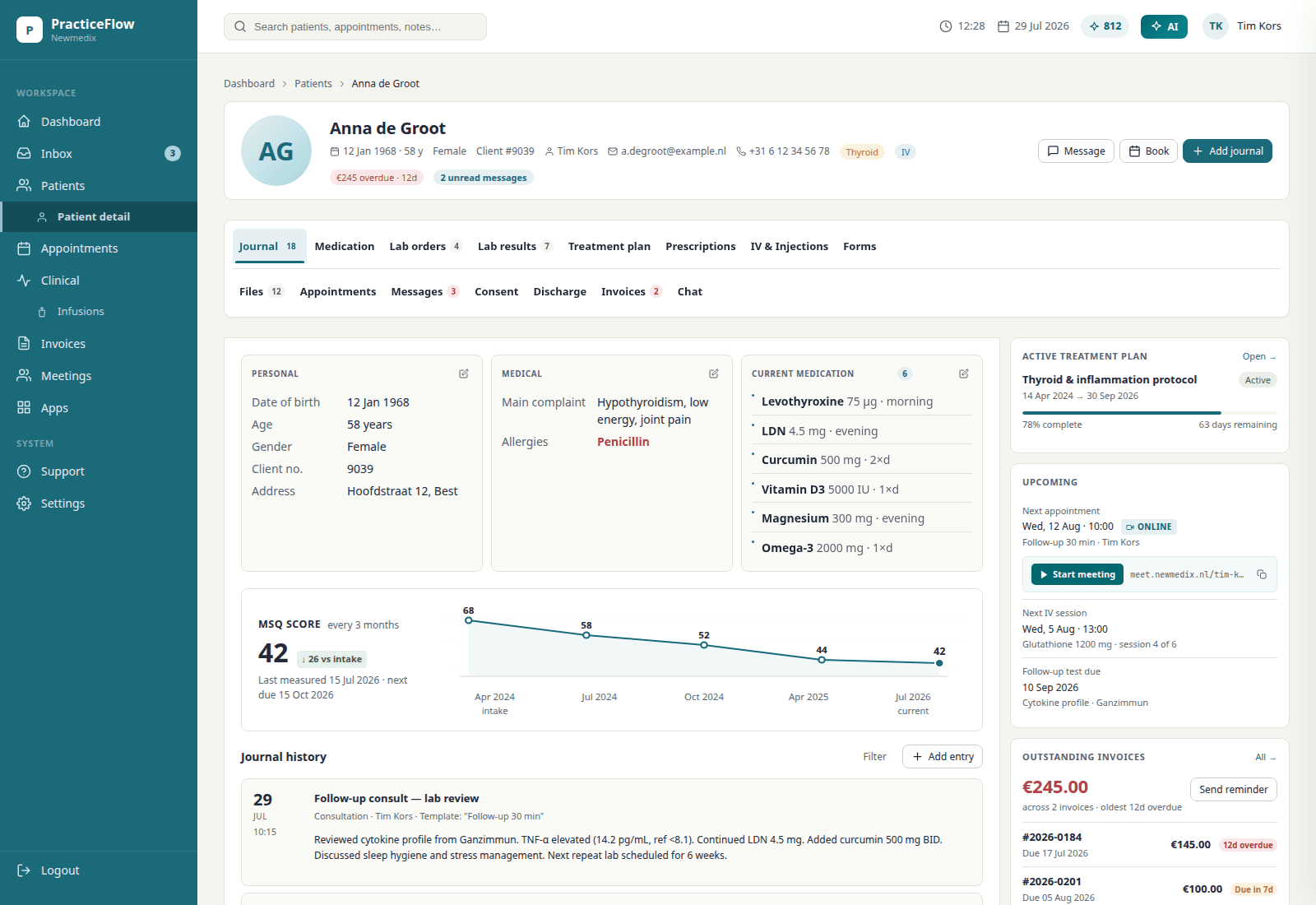
Software for a consult that is not fifteen minutes
A first functional medicine visit is a long conversation. Timeline, environment, sleep, diet, medication, prior labs, family history, what has already been tried. You cannot capture that in a note field designed for a sore throat. If you try, the real record ends up in a side document, and the side document is where evenings go to die.
Functional medicine software has to assume the visit is long. Appointments should open into the patient file, not a separate clipboard. Interview reports need structure you control — templates and snippets — so you are not rewriting the same paragraphs while the patient is still putting on their coat. The point is not to type less clinical content. The point is to finish the note before they leave the building.
I still see practices running the consult in one tool and the write-up in another. That split is expensive. The patient felt heard. Then you spend the night reconstructing what you heard. Practiceflow was built so the interview, the medication overview and the emerging plan sit on the same chart while you are still in the room. That is the job of the EMR view, and it is why this category is not interchangeable with generic practice software.
Labs, treatment plans and follow-up in one arc
The consult is only the start. You request labs from the labs you already work with. Results come back in different PDFs, different portals, different layouts. Then you write a plan: supplements, medication, maybe an infusion, nutrition, a retest window. Then nothing happens unless someone owns the follow-up.
Functional medicine software has to keep that arc in one place. Lab requests logged against the patient. Drop a lab PDF on the file and the live AI parser puts the values into lab results — no retyping. Repeat panels you can reorder from the last request. A plan that prints as one PDF the patient can actually follow. Reminders tied to the plan — recheck labs, taper, next consult — so a twelve-week protocol does not stall at week seven because nobody queued the retest.
When labs live in a shared drive and the plan lives in a Word file, you are not practising functional medicine software. You are practising file management. I wrote about that failure mode in lab results management and in the retesting schedule. The operational handoff after the PDF arrives is a clear lab follow-up workflow: who ordered the test, who reviews it, who tells the patient, and who owns the next action. The category test is simple: can you answer, from one file, which markers you ran, what you recommended, and when you said you would look again?
Follow-up is not a separate app. If the reminder is not tied to the plan, it is a sticky note. Long protocols stall at month three for operational reasons more often than for clinical ones. Software that cannot hold the retest date next to the markers you ordered is not finished software for this discipline.
Templates you own, not a locked protocol library
Every practice has a way of taking an intake. Every practitioner has phrases they trust. Functional medicine software should start from your templates and your protocols, then let you adjust per patient. If the vendor owns the only library, you will spend the first six months fighting someone else’s idea of an IFM visit.
In Practiceflow you build interview reports and treatment plans from templates you control. Snippets cut the retyping. Standard protocols stay consistent across practitioners, with patient-level edits. The library should get stronger every month because you used it, not because a vendor shipped a new PDF.
That is also how a small team stays coherent. A new practitioner should not mean a new set of Word files. Shared templates, shared medication overviews, one patient file. I cover the team shape on the EHR page and in multi-practitioner software. The category point is the same: templates are clinical infrastructure, not a nice-to-have.
I still get asked whether templates make the medicine generic. Only if you let them. The template is the floor: the questions you always ask, the protocol you usually start from. The consult is the exception. Software that forbids the exception is as useless as software that cannot remember the floor.
Grow the practice without stacking another tool
Most functional medicine practices do not start with a stack. They start with whatever was nearby: a generic EMR, a booking tool, a spreadsheet for quotes. It works until it does not. Then you add a lab portal, a form tool, a separate shop, an inbox that becomes a second clinic. Growth looks like more software. It feels like more evenings.
Functional medicine software, done properly, is the opposite of a stack. Intake, appointments, interviews, labs, plans, quotes, prescriptions, follow-up, portal, team access. One product. I built it to replace, in my own clinic, the side documents, the rebuilt invoices, the follow-up that only happened if I remembered it.
If you are comparing how practices actually grow, grow a functional medicine practice and reduce admin time are the operational essays. The owner-level page is practice management software. This category page is the through-line: do not buy five tools that each almost fit a long consult.
How to compare functional medicine software
Ignore the dashboard screenshots. Every vendor has a dashboard. Ask five questions that match the work.
One: does the chart assume a long-form intake of 60 to 90 minutes, or a 15-minute visit with extra fields? Two: can you request labs from the labs you already use, and keep results on the same patient file? Three: can a treatment plan include supplements, medication, infusions and nutrition in one document the patient takes home? Four: does follow-up live on the plan, or in someone’s head? Five: if you add a practitioner next year, do they inherit your templates or start a parallel clinic in a laptop folder?
If a product fails those questions, it may still be excellent software for someone else. It is not functional medicine software for the way this work actually runs. Walk the screens on the product tour if you want to see how Practiceflow answers them. Start for free if you want to try it on a real file of your own — no credit card.
A sixth check, if you want one: does the vendor talk like a clinic or like a platform? I am still in practice. Support has to understand a functional medicine intake. That is why I did not want to buy a tool whose ticket queue thinks an infusion is a billing code and a long-form intake is an extended appointment type you should not use.
A seventh check: is the software HIPAA and GDPR compliant, with data hosted in a way you can defend to a patient? Practiceflow is both. It is also the trust line I would not skip in a functional medicine practice where you handle detailed lab histories and lifestyle data.
Where Practiceflow sits next to tools you already know
Practices comparing this category usually already have a shortlist. Practice Better, Cerbo, OptiMantra and Hero EMR are real products, used by real clinics. I am not going to publish a feature table. Those sites will tell you their own pricing. See pricing for ours — by client volume, in dollars.
What I will say is how I chose to build. Practice Better is often in the conversation when a practice wants client management and programmes. Cerbo and OptiMantra show up when people want an EMR with more clinical depth. Hero EMR appears on lists of functional and integrative charts. Each of those tools will fit some practices well. None of them was the shape of my clinic: IFM-style intakes, labs from any provider I already used, plans that mixed supplements and infusions, quotes that should not live in a spreadsheet.
If your practice looks like a coaching programme with light labs, a different product may be the honest fit. If your practice looks like mine — long consults, mixed labs, protocols that run for months — you want software built around that file, not around a generic visit. Read the EMR and EHR pages for the two close-ups. Mixed-modality clinics should also read integrative medicine EHR. Then watch the video tour or start for free.
EMR, EHR, integrative and practice-management are not four products. They are four ways practitioners search for the same clinic problem. Read the page that matches the pain you actually have, then walk Features if you want every screen.
From practitioners already using it
These are the published quotes, word for word. No invented reviews.

“With Practiceflow, I keep track of my patient interview reports in a very user-friendly way. Also, I have a particularly good overview of the total treatment for the client. A real 'all-in-one solution': everything is clear from the first appointment to the last treatment. As a result, considerably fewer questions via email/telephone.”

“I work as a functional medicine doctor. With the software, a patient-personalized treatment plan is ready in a matter of minutes. Requesting lab tests and using text templates also saves me a lot of time, so I have more time and focus for the patient.”

“As a functional nutritionist, I use the software to make treatment plans and interview reports. Practiceflow is very user-friendly, easy to use, and easy to learn. With Practiceflow, I can do patient file management at least 50% faster.”
Still writing treatment plans at 9pm?
About 20 questions on how your intakes, lab portals and plan write-ups actually run. You get a report back showing which step is eating the hours.
Questions
Keep reading: Functional medicine EMR · Functional medicine EHR · Practice Better alternative · See every screen · Free practice scan · Blog
