
For practice owners
Functional medicine practice management software
I am Tim Kors, IFM Certified Functional Medicine Practitioner. I have owned a practice since 2006. Practice management software, in a functional medicine clinic, is not a nicer calendar. It is whether the consult is the work, or the work is everything around the consult: the ninety-minute write-up after hours, labs in three portals, quotes rebuilt by hand, follow-up that only happens if you remember it on a Sunday.
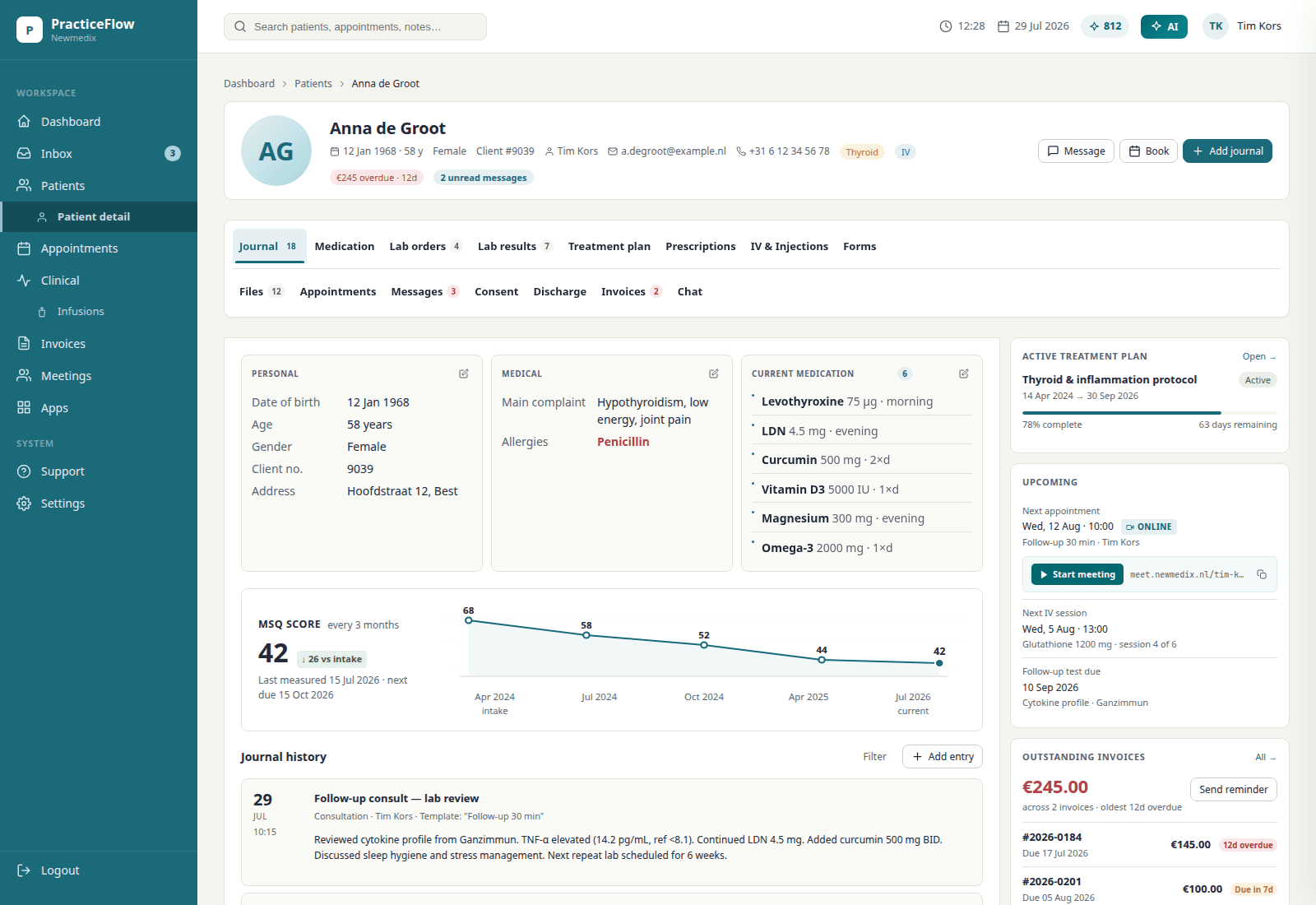
I built Practiceflow as the system I wanted to run: intake, labs, treatment plans, quotes, follow-up, portal, team access. One product. This page is the owner and ROI view — time, leakage, one system versus a stack. The category argument lives on functional medicine software. The screen-by-screen tour is Features. The leaks I actually had to close are the ones described here.
Owners compare tools while still seeing patients. I did too. The useful comparison is not a logo row. It is whether Tuesday night is still admin. If you want the five buyer questions, they are on the category page. This page is what happens to the practice when those questions are answered by one system.

Time back to the consult
Owners feel busy and behind at the same time. The calendar looks full. The evening is still documentation, chasing labs, answering “quick questions” that are really an unclear plan. Why your practice feels busy but falls behind is the pattern. Practice management software should return time to the visit, not add a dashboard you check instead of sleeping.
Isabelle Arts describes a personalised plan in minutes and more focus for the patient because labs and templates are not a second job. Ricky Crompvoets describes file management moving faster because the tool is learnable. That is the owner outcome: the consult is the product again.
Start from your own templates. Try the workflow on a real file. Start for free, no credit card. If the charting surface is the pain, also read the EMR. If the missing years of context is the pain, read the EHR.
I did not build a practice-management layer on top of someone else’s chart. I built the chart I was willing to live in, then kept the operations on that same object: appointments that open the file, plans that become quotes, follow-up that is already dated. Time comes back because the work is not duplicated. That is the whole owner thesis.
Admin out of inboxes and spreadsheets
Admin in a functional medicine practice hides in polite places: the inbox, the spreadsheet, the shared drive, the lab portal. Reduce admin time and AI admin automation are about that leak. Practice management software should make the default path the file, not the inbox.
Quotes that rebuild every time a plan changes are owner work disguised as finance. Treatment plans that cannot become a quote are two systems pretending to be one. Features covers quotes. The owner point is: stop running billing in a side spreadsheet if the plan already knows the products. When Friday is still a pile of invoices, build a repeatable billing workflow that checks the completed visit, the service, the invoice, and the recorded payment status, and names who owns each mismatch. See pricing for paid plans — by client volume, in dollars.
Inboxes are where unclear plans go to multiply. Patient communication is the essay. Practice management software should make the plan the default answer so the inbox is not a second unpaid clinic. I will not promise zero email. I will promise a file that can carry the plan without you retyping it into a reply at 21:00.
Follow-up that happens without heroics
Retention in functional medicine is not a rebooking trick. It is whether the retest was scheduled, the plan was clear, and someone closed the loop at week seven. I wrote the hidden revenue of automated follow-up and patient retention about that. Before you automate the stack, decide what to automate first by how often a task repeats and who still checks the exception.
When follow-up lives on the record, programmes finish. When it lives in your head, revenue leaks and patients drift. That is an operations fact, not a growth hack. Liana Verberg’s fewer emails and calls is the same loop seen from the practitioner side: the plan was clear, so the inbox calmed down.
Owners notice leakage as “we’re busy but not growing.” Often the calendar is full of new intakes while month-three retests never landed. Follow-up that happens is not a CRM drip. It is a clinical date on the same plan you already wrote. That is why this page links the category and Features rather than inventing a funnel.
A shareable team file
Owners eventually hire. If the “system” is one person’s habits, hiring is a second practice. Team productivity and multi-practitioner software are the essays. Practice management means the file, the templates and the portal survive a new practitioner.
Onboarding measured in days, not a re-implementation. Shared protocols with patient-level edits. That is how a clinic stays one clinic.
If the owner is still the only person who can find last year’s labs, you do not have a practice. You have a dependency. Shareable files are how you take a holiday. I say that as someone who built the tool because I needed the clinic to run without me re-exporting Word documents for a colleague.
Practice management, for this discipline, is also what you stop buying. Another form tool. Another lab inbox. Another sheet for quotes. Each purchase felt cheap. The stack was not. One system is the owner decision hiding under those subscriptions.
One system versus a stack
The stack looks rational at each purchase: booking here, notes there, labs in a portal, quotes in a sheet, email for everything else. Then you cannot answer a simple operational question without four logins. Grow a functional medicine practice and how to choose functional medicine software are the buyer-side pieces. This page is the decision: one system shaped like the work, or a stack shaped like vendor categories.
Practice Better, Cerbo, OptiMantra and Hero EMR are real alternatives you will evaluate. Some owners will pick them. I will not table-rank them. I built Practiceflow so I was not the integration layer between tools. If that is your problem, start free and walk Features. If you still need the category definition, go to functional medicine software.
ROI without invented numbers
I will not tell you a fabricated percentage. Ricky’s quote says he can do patient file management at least 50% faster — his sentence, and I will not extrapolate it into a calculator. The ROI I trust is qualitative until you try a real file: notes finished in the visit, fewer “what do I take?” emails, follow-up that was already on the plan, quotes that did not need a parallel spreadsheet.
Start for free, no credit card. See pricing for paid plans — by client volume, in dollars. This website does not store charts.
If you want a number, use Ricky’s published sentence and nothing else. If you want a method, put one patient through intake, labs, plan, quote and a follow-up reminder and see what you still do in email. That experiment is the ROI. I will not dress it up as a case study with invented revenue.
I have owned the practice since 2006. The software exists because I was tired of being the integration layer. Owners who are still that layer already know. Category page for the definition. Features for the tour. This page for the decision to stop stacking.
ROI, in my clinic, looked like this: the follow-up was already dated, the quote did not need a rebuild, the practitioner covering a day could open the file. I will keep the free start so you can see whether your Tuesday night changes. See pricing for paid plans. Get a demo if you want a walkthrough first.
From practitioners already using it
These are the published quotes, word for word. No invented reviews.

“With Practiceflow, I keep track of my patient interview reports in a very user-friendly way. Also, I have a particularly good overview of the total treatment for the client. A real 'all-in-one solution': everything is clear from the first appointment to the last treatment. As a result, considerably fewer questions via email/telephone.”

“I work as a functional medicine doctor. With the software, a patient-personalized treatment plan is ready in a matter of minutes. Requesting lab tests and using text templates also saves me a lot of time, so I have more time and focus for the patient.”

“As a functional nutritionist, I use the software to make treatment plans and interview reports. Practiceflow is very user-friendly, easy to use, and easy to learn. With Practiceflow, I can do patient file management at least 50% faster.”
Still writing treatment plans at 9pm?
About 20 questions on how your intakes, lab portals and plan write-ups actually run. You get a report back showing which step is eating the hours.
Questions
Keep reading: Functional medicine software · See every screen · Functional medicine EHR · Free practice scan · Blog
