
Charting
Functional medicine EMR
I am Tim Kors, IFM Certified Functional Medicine Practitioner. I opened my own practice in 2006. For about ten years I did what every functional practitioner does — finished the consult, then reconstructed it after dinner because the chart could not hold the intake. In 2017 I started building a functional medicine EMR that assumed the visit I actually run. Mine are not ten minutes. An intake is an hour to an hour and a half of timeline, environment, medication, prior labs and the thing the patient actually came for. If the EMR cannot hold that, you finish the visit and then start the real work after dinner — while the labs are still sitting in three portals.
A functional medicine EMR is the charting surface: interview templates, snippets, the medication overview, the plan taking shape on the same screen. It is not the whole category. The long file — years of labs and follow-up your team and your patient can both see — is the functional medicine EHR. The category hub is functional medicine software. This page is about getting the note done while the patient is still here.
Charting a long-form consult
Generic EMRs are fast at short visits. They are slow at ours. You spend the consult holding eye contact and then you spend the evening reconstructing a timeline that should have been structured as you went. That is not a discipline problem. It is a chart that does not match the visit.
A functional medicine EMR has to let you work in the length of visit you actually book: intakes, follow-ups, infusions, phone consults. The appointment should open the file, not a blank pad. I wrote about the documentation tax in functional medicine documentation and about AI documentation as a way to absorb mechanical typing — not as a replacement for judgement. Transcription is only useful if the output lands on the chart, which is why AI transcription for consults sits next to this page, not instead of it.
The test I use: when the patient stands up, is the interview report substantially there? If the honest answer is no, you do not have a functional medicine EMR. You have a filing cabinet that waits until 9pm.
I have run this clinic since 2006. The evenings did not get shorter because I got more disciplined. They got shorter when the chart stopped asking me to reconstruct the visit from memory. That is the only EMR metric I trust: were you still at the keyboard after the last patient left, or were you done?
Templates and snippets you control
I do not want a vendor’s idea of an IFM intake locked into my chart. I want my headings, my phrases, my follow-up structure — then the ability to deviate for this patient. Templates and snippets are how you stop rewriting the same paragraph about sleep or gut history for the hundredth time without flattening the person in front of you.
In Practiceflow, interview reports for intake and follow-up are built on templates you own. Text templates and snippets cut the retyping. Everything stays searchable and comparable over time. That is how a full intake report can be finished before the patient has left the building — the workflow behind our AI documentation approach. It is the outcome Isabelle Arts describes when she talks about text templates and lab requests saving time for the patient in the room.
If you are coming from Word, this feels like giving up flexibility. It is the opposite. Word is flexible until you need last year’s intake next to this year’s. Then Word is a hunt. A functional medicine EMR is a structured interview you can still write in.
Snippets are not autotext theatre. They are the sentences you already trust — sleep history, environmental exposures, how you explain a retest window — available without breaking eye contact for thirty seconds of hunting. You still edit. You still think. You just do not retype the scaffolding of your own method every Tuesday.
Interview, medication and plan on one chart
The failure mode I still see: interview in one place, current meds in a PDF, plan in a third document. During the consult you cannot see all three. After the consult you reconcile them by hand. That is how you miss a supplement the patient already takes, or write a plan that contradicts last month’s medication list.
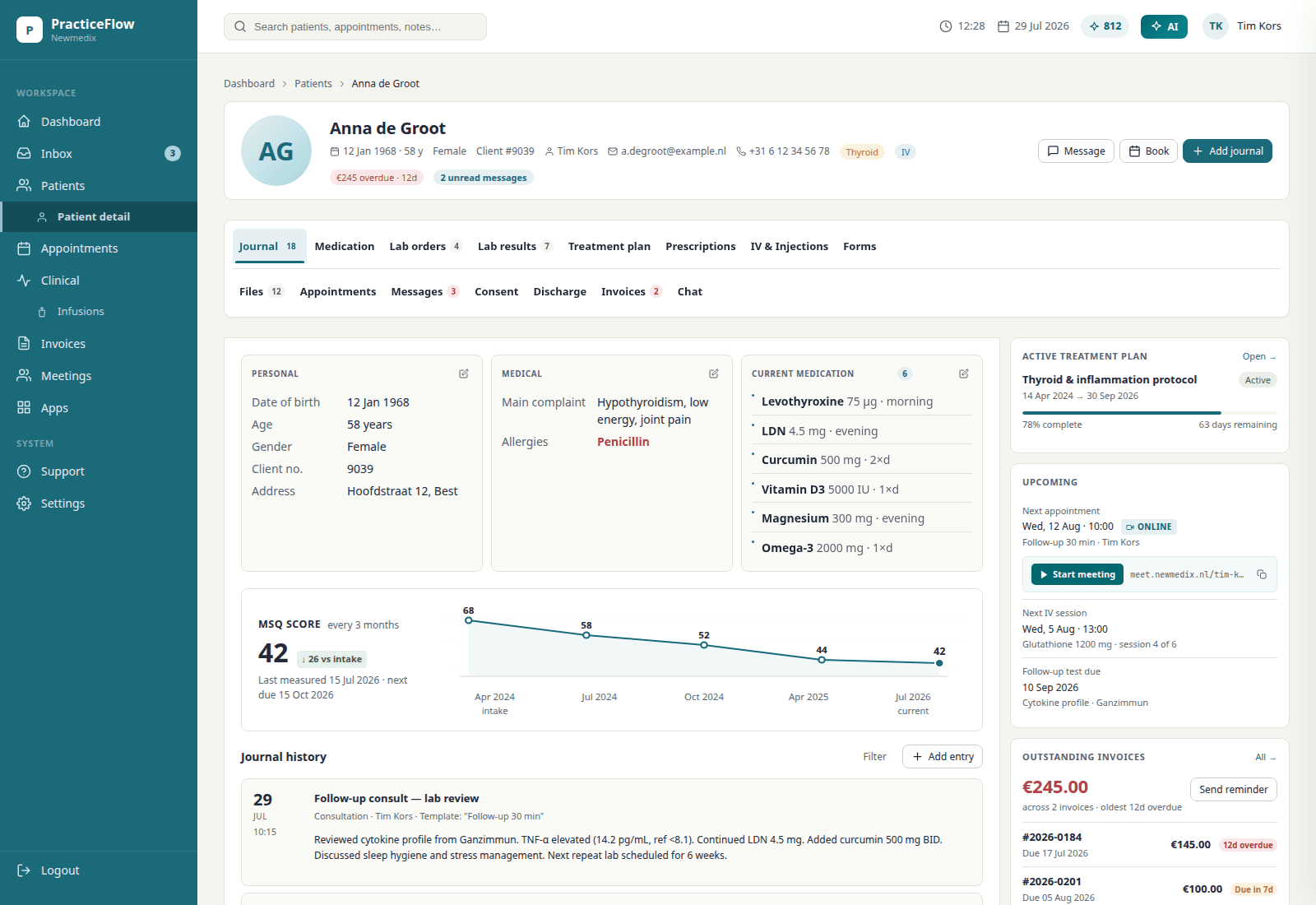
A functional medicine EMR keeps the interview report, the medication overview and the treatment plan on the same patient chart. You adjust the plan from a protocol template while the interview is still on screen. The patient leaves with one document. Quotes can follow from the plan without rebuilding pricing by hand — that is on the Features tour under quotes and treatment plans, not a separate billing product you have to remember to open.
Ricky Crompvoets uses Practiceflow as a functional nutritionist for treatment plans and interview reports. The speed he describes is not a magic number we invented for marketing. It is what happens when the chart stops being three tools.
Medication overview plus plan is also a safety issue, not only a speed issue. You cannot responsibly add a protocol if last month’s list is in a scan. Keeping current medication on the same chart as the interview is the minimum I was willing to ship for my own patients.
Searchable notes, comparable over time
Functional medicine is a longitudinal sport. You need to find what you said about fatigue in March when the patient returns in September. If notes are free text in a blob, search is a prayer. If notes are structured enough to search and still human enough to read, you can practise.
I built the EMR so interview reports stay searchable and comparable. Follow-up visits should not start with “remind me where we left off.” That sentence is a symptom of a chart that does not remember. The EHR page is about the years-long file. This page is about the visit that writes the next layer of that file without friction.
Comparable over time also means you can see whether the story changed. Symptom clusters, what you tried, what you did not repeat. That is clinical memory. A generic EMR stores encounters. A functional medicine EMR stores a case.
No side document after the consult
If you still open a second window to finish the note, the EMR has failed, even if it stored an appointment. The side document is where quality leaks and evenings disappear. Practiceflow was built so you do not need that window.
That does not mean every practice will chart the same way on day one. Bring your own templates. Try it on a real file. Start for free, no credit card. If the charting surface is the reason you came, stay here. If you need the whole operation — follow-up, portal, team — read practice management software and the category hub.
I built this for my own clinic first. Other practices use it now. The invitation is the same: put one real patient on the chart and see whether the side document disappears. If it does not, this is not your EMR.
EMR alternatives, without a comparison grid
When people say they are looking at a functional medicine EMR, the names that come up are often Cerbo, OptiMantra, Hero EMR, sometimes Practice Better if the practice is closer to programmes than to long clinical intakes. Those are real products. I will not score them in a table. You should read their sites.
I built Practiceflow because those options, as I experienced the market while running a clinic from 2006, did not match a long-form IFM intake with mixed labs and a plan that had to include infusions and supplements in one place. Your clinic may match a different product. The EHR page is the sister page: same software, emphasis on the record rather than the visit. Features is the screen-by-screen tour.
Bring a real consult. If the note is done when the patient leaves, you have an EMR. If you still open a side document, keep looking. I will not pretend every functional clinic needs this chart. I will say mine did, which is why I wrote it.
From practitioners already using it
These are the published quotes, word for word. No invented reviews.

“With Practiceflow, I keep track of my patient interview reports in a very user-friendly way. Also, I have a particularly good overview of the total treatment for the client. A real 'all-in-one solution': everything is clear from the first appointment to the last treatment. As a result, considerably fewer questions via email/telephone.”

“I work as a functional medicine doctor. With the software, a patient-personalized treatment plan is ready in a matter of minutes. Requesting lab tests and using text templates also saves me a lot of time, so I have more time and focus for the patient.”

“As a functional nutritionist, I use the software to make treatment plans and interview reports. Practiceflow is very user-friendly, easy to use, and easy to learn. With Practiceflow, I can do patient file management at least 50% faster.”
Still writing treatment plans at 9pm?
About 20 questions on how your intakes, lab portals and plan write-ups actually run. You get a report back showing which step is eating the hours.
Questions
Keep reading: Functional medicine EHR · Functional medicine software · See every screen · Free practice scan
